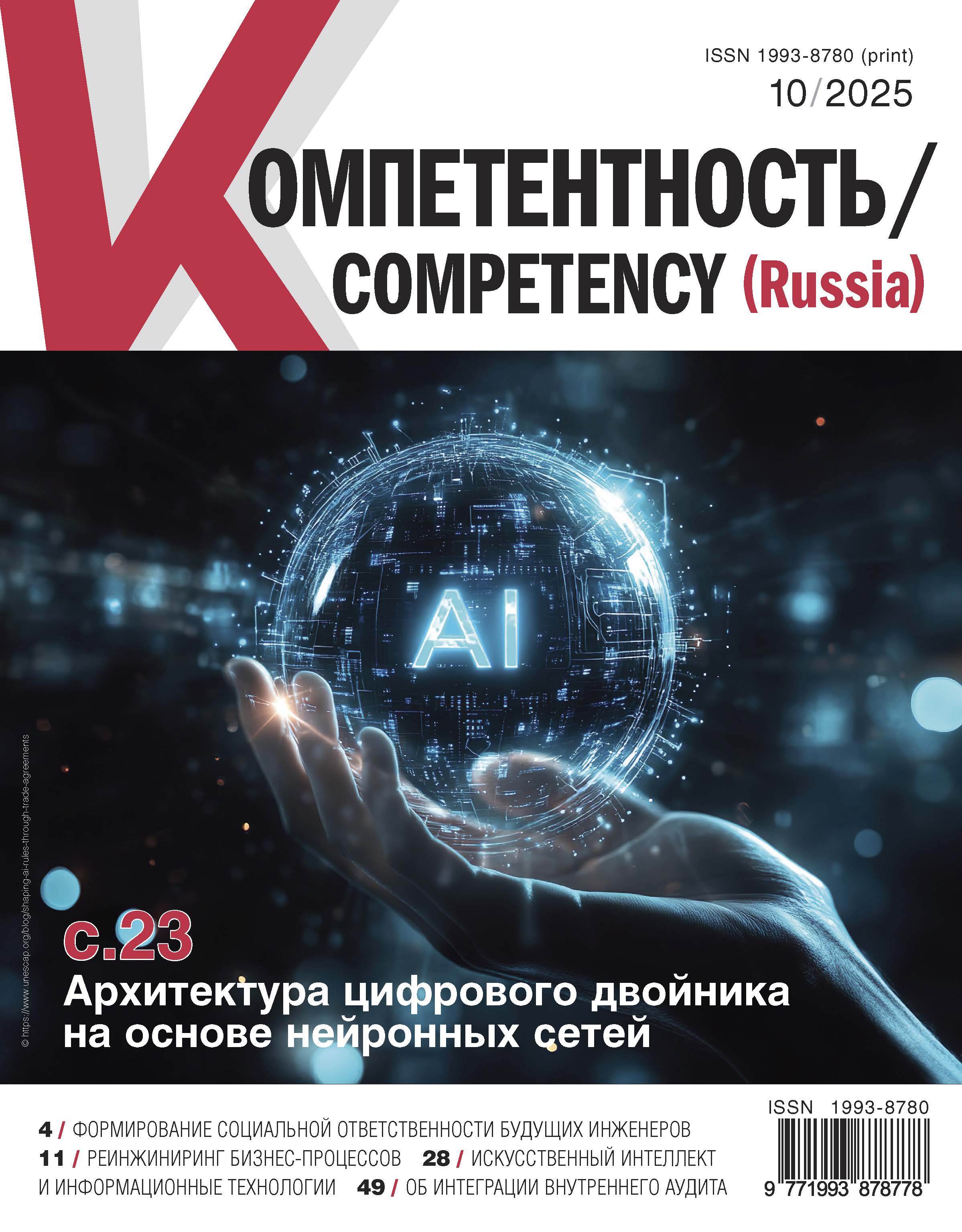
Journal Kompetentnost': 230 / 10 / 2025
Articles
-
1
Formation of Future Engineers Social Responsibility
Authors: D.A. Troeshestova, FSBEI HE Ulyanov Chuvash State University (FSBEI HE Ulyanov ChuvSU), Assoc. Prof. PhD (Phys.-Math.), sda-chuvsu@yandex.ruM.M. Mityugina, FSBEI HE Ulyanov ChuvSU, Assoc. Prof. PhD (Ec.), mityuginamm@gmail.comIn the article we have discussed the issues of forming future engineers social responsibility for their decisions and understanding the level of impact of engineering activities on society and the environment. The paper defines the essence of the concept of social responsibility, analyzes the competencies of the federal state educational standards of higher education, which form students social responsibility and their substantive implementation in the educational process. An approach to the development of social responsibility of future engineers is proposed through the prism of a project approach to the development of socially oriented projects aimed at ensuring the sustainable development of the city, taking into account the economic, legal and environmental agenda.DOI: 10.24412/1993-8780-2025-10-04-10
Download -
2
Reengineering of Business Processes: TPC and Economic Aspects of Their Functioning
Authors: M.G. Barinova, Voronezh Branch of FSAEI FVT Academy for Standardization, Metrology and Certification (Training) (Voronezh Branch of FSAEI FVT ASMS)Yu.M. Sapego, Voronezh Branch of FSAEI FVT ASMSA.I. Solyanik, Voronezh Branch of FSAEI FVT ASMS, Prof. Dr. (Tech.)In the new socioeconomic conditions, the reengineering of Academy for Standardization, Metrology and Certification (ASMS) main business processes, which is carried out to improve the quality of the educational process and develop new areas of activity, has become a defining factor in its economic sustainability. As the practice of Voronezh branch of ASMS has shown, one of the ways to ensure the effective functioning, continuous improvement and practical orientation of educational activities is the formation of educational and production complexes in its structural units. In the article, the approaches and experience of the branch in the formation of educational and production complexes as an effective direction for reengineering business processes, improving the business model and increasing the financial stability of an educational organization are considered. The economic aspects of the transformation are presented.DOI: 10.24412/1993-8780-2025-10-11-15
Download -
3
Methods of Economic Incentives of Staff as a Factor of the QMS Performance
Authors: A.S. Gimadeeva, Krasnodar Branch of Academy for Standardization, Metrology and Certification (Training), gimadeeva. as@asms.ruThe relationship between methods of economic stimulation of personnel and the effectiveness of quality management systems at Russian enterprises is investigated. The evolution of approaches to motivation in the context of quality management is considered. A model of economic incentives has been developed that focuses on the key processes of the quality management system. The main scientific problem of the study is the need for theoretical justification and methodological development of tools for economic incentives for personnel integrated with the quality management system and ensuring an increase in its effectiveness. The results of the study are of practical importance for Russian enterprises seeking to improve the effectiveness of quality management systems through more efficient use of economic mechanisms for motivating personnel. The proposed approach to integrating economic incentives into the process structure of the QMS ensures a systemic relationship between the individual economic interests of employees and the strategic goals of the organization in the field of quality.DOI: 10.24412/1993-8780-2025-10-16-22
Download -
4
Architecture of a Digital Twin for a Water Drainage System Based on Neural Networks
Authors: A.A. Berezina, St. Petersburg State University of Aerospace Instrumentation, anybaranova299751@yandex.ruThis article analyzes modern wastewater management systems for pulp and paper mills, revealing the systemic limitations of existing solutions for data integration and realtime monitoring. A multilevel digital twin architecture has been developed that integrates operational monitoring data, predictive algorithms based on artificial neural networks, and process optimization tools. A methodology for adapting various neural network architectures, including graph, recurrent, and convolutional networks, to the specifics of multicomponent wastewater from pulp and paper mills is proposed. A sevenmonth industrial trial confirmed the effectiveness of the developed solution: a 91 % reduction in COD exceedances, an annual savings of 8.4 million rubles due to reagent optimization, and the prevention of potential emergencies. The obtained results demonstrate the potential of applying artificial intelligence technologies to the creation of integrated wastewater management systems for industrial enterprises.DOI: 10.24412/1993-8780-2025-10-23-27
Download -
5
Artificial Intelligence and Information Technologies: Robotics
Authors: V.A. Grushnikov, All-Russian Institute for Scientific and Technical Information of the Russian Academy of Sciences PhD (Tech.), viniti@mach04.ruInformation technologies, which have become widespread and deeply embedded in various spheres of human activity, have already become not only an effective support, but also a real tool for research, development, experimental and ordinary operation of technical means. The use of the Internet of Things, for example, in logistics, has become by no means uncommon, but in the order of things, and not only in social networks. The capabilities of artificial intelligence in the form of neural networks and digital twins have significantly increased efficiency in terms of new products and productivity in terms of the resource intensity of technological processes. Without touching on the socioethical aspects of artificial intelligence, let’s try to trace its effectiveness and efficiency in mechanical engineering and transport. Let’s start with robotics.DOI: 10.24412/1993-8780-2025-10-28-35
Download -
6
Approach to the Formation of Expert Evaluation Results by the Weighted Sum Method
Authors: V.M. Korneeva, Bauman Moscow State Technical University, Prof. Dr. (Tech.), v_korneeva@list.ruA.A. Barzov, Lomonosov Moscow State University (Lomonosov MSU), Prof. Dr. (Tech.), a.a.barzov@gmail.comP.N. Sysoev, Lomonosov MSU, PhD (Phys.-Math.), pavelns87@ gmail.comI.S. Korneev, JSC Production Association TyazhPromMash, iskorn@icloud.comA probabilistic modification of the procedure of processing the results of expert evaluation by the known weighted sum method is proposed. The possibility of functional and probabilistic interpretation of influence coefficients in this method is shown, which essentially increases the flexibility of its use, especially for difficultly formalized objects of evaluation. On the example of predictive qualification of innovations at the early stages of their life cycle the procedure of probabilistic determination of influence coefficients of expertevaluation criteria of their quality is implemented. The prospects for the development of the proposed approach are outlined, in particular, through its application in computerized expertise systems using the multifunctional potential of artificial creative intelligence.DOI: 10.24412/1993-8780-2025-10-36-40
Download -
7
System for Ensuring Information Security and Implementation of Management Mechanisms
Authors: A.D. Georgievskiy, MIREA — Russian Technological University (RTU MIREA), ausey@bk.ruYu.Yu. Cheremukhina, RTU MIREA, PhD (Tech.), cheremukhina@mirea.ruIn the context of the rapid development of digital technologies, ensuring information security is of key importance for the sustainable functioning of organizations and government structures. The effectiveness of the information security system is determined not only by the technical means of protection used, but also by the management system, which includes formalized procedures for evaluating, monitoring and improving security measures. The article considers an approach to the formation of a set of indicators that allow an objective assessment of the current state of the information security system and the effectiveness of the implemented management mechanisms. The classification of indicators by levels is proposed: strategic, tactical and operational. Special attention is paid to the relationship between performance indicators and compliance indicators. The existing assessment methods in domestic and foreign practice are considered, as well as recommendations for adapting indicators to the specifics of a particular organization are given.DOI: 10.24412/1993-8780-2025-10-41-43
Download -
8
On Change of Requirements to Eco-Labeling in Russia
Authors: E.A. Sysoeva, FSBEI HE Ogarev National Research Mordovia State University, Assoc. Prof. Dr. (Ec.), sysoewa@mail.ruThe global trend towards greening consumption has led to the widespread use of green terminology in marketing, often without proper documentation of the environmental characteristics of products. Until 2018, the Russian organic products market lacked clear legal regulation. The introduction of the Federal Law On organic products and amendments to certain legislative acts of the Russian Federation laid the conceptual foundation for the organic food industry. The article examines regulatory aspects of the organic products market, the economic consequences for market participants, consumer protection mechanisms against unfair practices, and prospects for the development of the certified organic products market. An analysis of law enforcement practices identifies key challenges in implementing new ecolabeling requirements.DOI: 10.24412/1993-8780-2025-10-44-48
Download -
9
Accredited and Certified Organizations: Internal Audit Integration
Authors: A.A. Bodyagin, FBI State Regional Center for Standardization, Metrology and Testing in Samara Region (FBI Samara CSM)I.K. Andronchev, Samara Branch of FSAEI FVT Academy for Standardization, Metrology and Certification (Training) (Samara Branch of FSAEI FVT ASMS), Prof. Dr. (Tech.)S.L. Aleksandrov, Samara Branch of FSAEI FVT ASMS, FBI Samara CSM, PhD (Tech.), Senior Researcher, stalek@bk.ruWe have proposed a dependence for calculating the integration levels, determined by the ratio of the number of general and additional individual requirements, taking into account the complexity of documentary formalization and the labor intensity of the work for the latter. It is stated that the managed integration of regulatory document requirements reduces the number of internal documents and allows for monitoring the fulfillment of requirements simultaneously for different types of activities and local management systems of accredited and certified organizations. We have recommended to use quality management system tools to improve the internal audit system — assessing the risks and opportunities of each process at different management levels and each function of the PDCA cycle.DOI: 10.24412/1993-8780-2025-10-49-56
Download