Journal Kompetentnost': 229 / 9 / 2025
Articles
-
1
Cross‑Functional Organizational Structure in the Context of Digital Transformation
Authors: A.R. Bestugin, Sant Petersburg State University of Aerospace Instrumentation, Prof. Dr. (Tech.)I.A. Kirshina, Assoc. Prof. PhD (Ec.), ikirshina@mail.ruE.M. Il’inskaya, Prof. Dr. (Ec.), tempra_2001@mail.ruWe have analyzed the importance of the cross-functional structure in the context of digital transformation, as well as the importance of integration in the personnel structure for increasing competitiveness. A characteristic of the cross-functional structure is given, highlighting the positive aspects. In the article, we have formulated the tasks and paid more attention to the stages of forming cross-functional teams in a cross-functional structure. A formula is proposed for calculating the synergy effect of combining personnel components. The main points necessary for the effective functioning of the cross-functional organizational structure of the company are highlighted. The model of cross-functional management and methods for calculating the effectiveness of a cross-functional team are described separately.DOI: 10.24412/1993-8780-2025-9-03-08
Download -
2
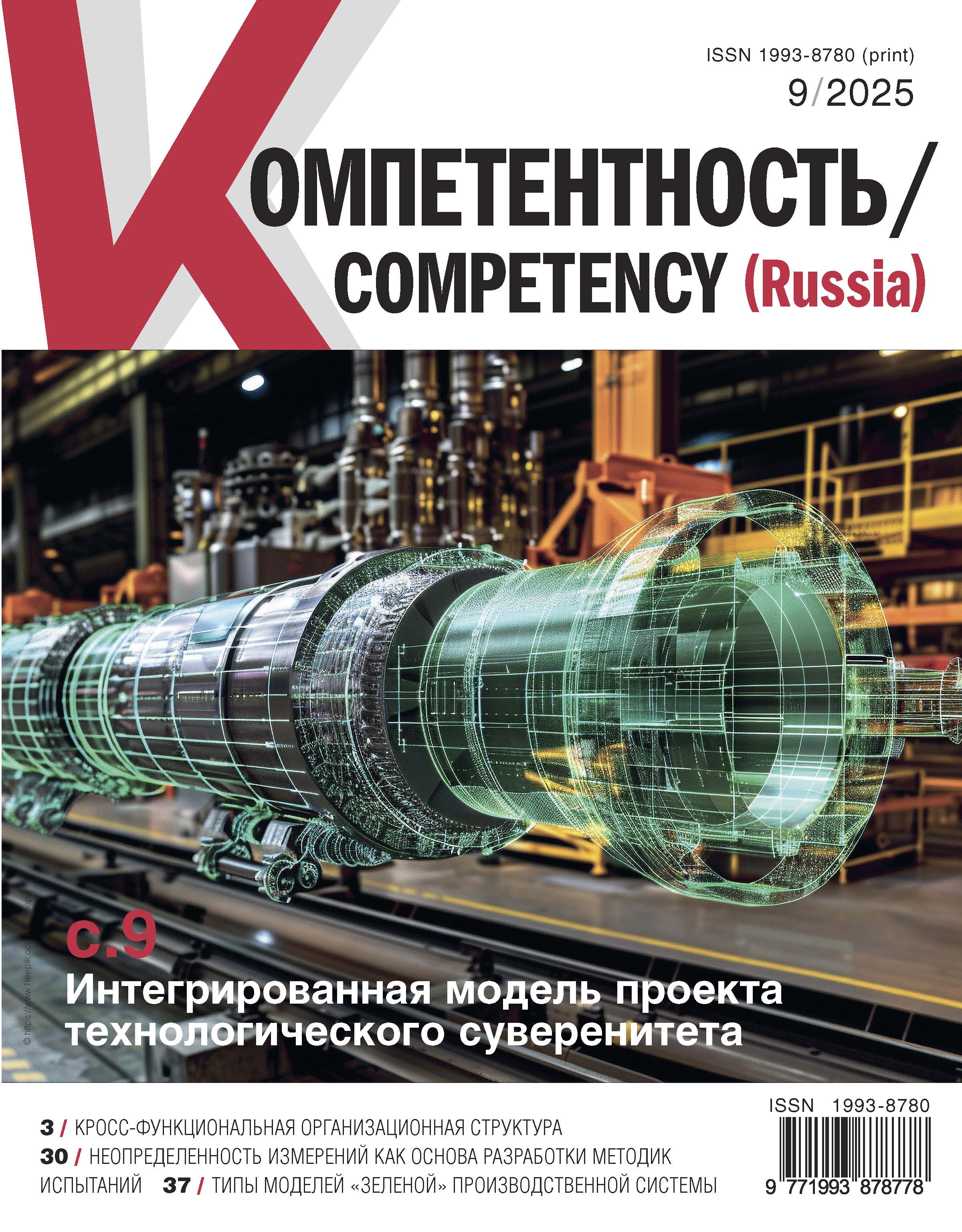
Integrated Model of the Technological Sovereignty Project in Engineering Industry
Authors:V.P. Meshalkin, International Institute of Resource Saving Logistics and Technological Innovation of Mendeleev University ofChemical Technology of Russia, Prof. Dr. (Tech.), Academician of the Russian Academy of Sciences, vpmeshalkin@gmail.comYa.V. Denisova, FSBEI HE Kazan National Research Technological University, Assoc. Prof. PhD (Ec.),yana-denisova@inbox.ruIn an era of rapid technological advancements and global competition, the concept of technological sovereignty has become increasingly relevant. Technological sovereignty is a key factor in determining a country’s economic strength, its national security, and independence from external suppliers. In the article, the principles of building an integrated model of the technological sovereignty project are defined, the structure of the integrated model of the technological sovereignty project is developed, the production process of import-substituting products in the implementation of the technological sovereignty project is considered, and an approach to assess the effectiveness of the integrated model of the technological sovereignty project is proposed.DOI: 10.24412/1993-8780-2025-9-09-15
Download -
3
The Sociotechnical Nature of Organizational Ambidexterity in a High‑Tech Enterprise
Authors: V.A. Leventsov, FSAEI HE Peter the Great St. Petersburg Polytechnic University, Assoc. Prof. PhD (Ec.), vleventsov@spbstu.ruM.Yu. Nurulin, LLC Special Technology Center, mikhail.nurulin@gmail.comIn modern medicine, the term ambidexterity refers to a person’s ability to independently and equally effectively use both hands. In organizational management, the equivalent of this function is research and production, which are often considered to be opposite activities. This article analyzes the essence of ambidexterity as an organization’s ability to combine research and production activities to ensure sustainable development. A conceptual model of systemic ambidexterity is proposed, demonstrating its sociotechnical nature, key components and key factors shaping its essence are identified. Based on experience in IT project management, the need to ensure social interoperability in project management is demonstrated.DOI: 10.24412/1993-8780-2025-9-16-21
Download -
4
Development of Principles for Small‑Tonnage Chemicals Multi‑Product Production Managing
Authors: M.Yu. Knyazev, FSBEI HE Kazan National Research Technological University (FSBEI HE KNRTU), LLC Investment and Industrial Concern ZVEZDA, PhD (Ec.), diskmy20242026@gmail.comA.I. Shinkevich, FSBEI HE KNRTU, Prof. Dr. (Ec.) Dr. (Tech.), ashinkevich@mail.ruThe study considers management principles for multi-product small-tonnage chemical production systems, using deep toluene processing complex as a case study. The work addresses the need for flexible, modular chemical production capable of rapid adaptation to market demands while minimizing costs and environmental impact. Key objectives include the analyses modular organization and flexibility in chemical-technological systems (CTS), proposing management principles for small-tonnage facilities, and demonstrating their application in a toluene-processing complex producing high-value derivatives like benzyl chloride, benzyl alcohol, benzoic acid, benzyl benzoate, etc. In our research, we have identified three flexibility types: technological, equipment, and structural, enabling production line reconfiguration. A modular equipment design allows versatile assembly for diverse processes. The toluene complex case study demonstrates production of 6+ products with shared infrastructure, emphasizing market-driven optimization and digitalization. Key findings: modular CTS reduces capital costs by 20–30% while enabling faster product switching; digital monitoring enhances multi-product operation precision. The proposed framework supports Russia’s import substitution goals in pharmaceuticals and specialty chemicals. The approach is scalable to the other small-tonnage systems, aligning with global trends toward sustainable chemical manufacturing.DOI: 10.24412/1993-8780-2025-9-22-29
Download -
5
Accounting for Measurement Uncertainty Sources as the Basis for Developing Test Methods
Authors: E.S. Shemelin, FSAEI FVT Academy for Standardization, Metrology and Certification (Training), e.shemelin@gmail.comThis paper analyzes the requirements for analytical weights in a number of interstate standards developed based on international standards for test methods. It is shown that incorrect interpretation of the terms precision, accuracy and sensitivity can lead to the establishment of technically impossible requirements. Based on modeling the uncertainty of density measurements using the apparent mass method, the sufficiency of using weights of high (II) and special (I) accuracy classes is justified, as well as the inexpediency of more stringent requirements. The purpose of the work is to demonstrate the need for a transition to a system for developing test methods based on a quantitative assessment of sources of uncertainty, which is consistent with the principles of a risk-based approach and contributes to improving the effectiveness and reliability of conformity assessment.DOI: 10.24412/1993-8780-2025-9-30-36
Download -
6
Types of Green Production System Models
Authors: I.A. Yumankin, FSBEI HE Kazan National Research Technological University (FSBEI HE KNRTU), ilnic@list.ruR.K. Nurgaliev, FSBEI HE KNRTU, Assoc. Prof. Dr. (Tech.), nurgalievr@gmail.comThis paper analyzes the requirements for analytical weights in a number of interstate standards developed based on international standards for test methods. It is shown that incorrect interpretation of the terms precision, accuracy and sensitivity can lead to the establishment of technically impossible requirements. Based on modeling the uncertainty of density measurements using the apparent mass method, the sufficiency of using weights of high (II) and special (I) accuracy classes is justified, as well as the inexpediency of more stringent requirements. The purpose of the work is to demonstrate the need for a transition to a system for developing test methods based on a quantitative assessment of sources of uncertainty, which is consistent with the principles of a risk-based approach and contributes to improving the effectiveness and reliability of conformity assessment.DOI: 10.24412/1993-8780-2025-9-30-36
Download -
7
Features of Qualimetric Quality Assessment
Authors: I.I. Antonova, PEI HE Timiryasov Kazan Innovative University (PEI HE Timiryasov KIU), Prof. Dr. (Ec.)V.A. Smirnov, PEI HE Timiryasov KIU, Prof. Dr. (Tech.)Yu.A. Repina, PEI HE Timiryasov KIU, Assoc. Prof. PhD (Soc.)A.T. Khadieva, PEI HE Timiryasov KIU, PhD (Ec.)K.S. Antonov, Institute of Information Technology and Intelligent Systems of Kazan Federal UniversityThe authors focus on the assessment of quality based on its universal definition given by the relevant standard and the fundamentals considered by qualimetry. From the perspective of qualimetry, quality is the degree of compliance with the standard (ideal). In addition to all procedures and parameters, the requirement of quality compliance must necessarily take into account the factor of competitiveness. Authors are clarified the classification of the qualimetric quality assessment methods, it is shown that this type of assessment is the most effective for improving any type of activity.DOI: 10.24412/1993-8780-2025-9-43-45
Download -
8
Tubular Furnaces for Primary Oil Refining Using a Digital Twin
Authors: A.E. Salyakin, FSBEI HE Kazan National Research Technological University (FSBEI HE KNRTU), mcrofficial182@gmail.comE.V. Garifullina, FSBEI HE KNRTU, PhD (Tech.)V.V. Bronskaya, FSBEI HE KNRTU, PhD (Tech.)A.G. Mukhametzyanova, FSBEI HE KNRTU, Dr. (Tech.)One of the promising areas of digitalization is the optimization of the operation of the most labor-intensive sections of technological installations using digital twins — virtual models of the technological process or equipment, which contain the main characteristics of state of the real object. Such a model allows you to analyze the efficiency of the process under different operating conditions and obtain information about critical parameters in advance. The most challenging aspect of operating technological installations is the tubular furnaces, which are designed to heat the working medium using the combustion products of hydrocarbon gas. This article describes the problems of using tubular furnaces in primary oil refining plants and their impact on operating costs and product quality, and proposes a method for optimizing costs and maintaining quality based on a virtual model in a computer software package.DOI: 10.24412/1993-8780-2025-9-46-49
Download -
9
Innovative Technology for Restoring Disturbed & Oil‑Contaminated Lands
Authors: S.G. Mar’inskikh, LLP Altai Geological and Environmental Institute, Assoc. Prof. PhD (Biol.), marinskih@bentonit.ruO.S. Ostakh, Gubkin Russian State University of Oil and Gas (Gubkin University), Assoc. Prof. PhD (Tech.), Mironova_Ok@mail.ruA.V. Golovenko, Gubkin University, andreigo1ovenko@yandex.ruD.M. Komarov, Gubkin University, kom_di01@mail.ruS.V. Ostakh, Institute of Physical Chemistry and Electrochemistry of the Russian Academy of Sciences, Assoc. Prof. PhD (Tech.), ostah2009@yandex.ruAccording to the research results, the effectiveness of bentonite clays as part of the Bio-HMC complex for the reclamation of oil-polluted lands has been confirmed, in which bentonite clays from Tagansky and Kaibalsky deposits with a high content of montmorillonite are used as a mineral component. The stabilizing effect on humus components is expressed in maintaining their concentration at the level of control values due to the formation of various bonds between humates and rock minerals. For a more accurate assessment of the density of multicomponent mixtures, it is necessary to additionally perform phytotesting of the substrate. The highly effective combined action of humic acids together with bentonite makes it possible to reduce the scale of environmental pollution, ensure their neutralization and disposal for further use in the reclamation of disturbed and oil-contaminated lands.DOI: 10.24412/1993-8780-2025-9-50-56
Download -
10
Mentoring in High‑Tech Industries: How to Transform Practice into a System
Authors: N.R. Verbitskaya, FSUE Mendeleev Institute for Metrology, n.r.verbitskaya@vniim.ruStarting from March 1, 2025, after the introduction of article 351 in the Labor Code of the Russian Federation, the approach to mentoring has been revised, and it has become an official part of labor relations. This is not just a new development, it signifies the recognition by the government that knowledge transfer is not just educational work but a strategic resource. Mentoring is considered as a strategic tool for human capital management in high-tech industries, as an element of the quality economics and innovative sustainability of an organization. KPI system for assessing program results is proposed. Digital tools for transforming mentoring into a manageable process are considered, and the effectiveness of mentoring is demonstrated.DOI: 10.24412/1993-8780-2025-9-57-60
Download