Journal Kompetentnost': 233 / 3 / 2026
Articles
-
1
Formation of a Structured Knowledge Base Based on the Documentation Classifier
Authors: Yu.A. Klyuchnikova, National Research Tomsk Polytechnic University (TPU), yak45@tpu.ruV.A. Maksimova, TPU, vam77@tpu.ruI.V. Plotnikova, TPU, Assoc. Prof. PhD (Tech.), inna@tpu.ruAny organization in its business activities may face issues of inefficient handling of documents and the urgent need to build a knowledge base for all aspects of activity. The main problems in this case are the non-preservation of documents from loss and damage, duplication, lack of clear search, loss of knowledge accumulated by employees when they leave the organization. One of the foundations for the sustainable functioning of an enterprise is a transparent system of document flows and clear principles for handling all types of documentation. This article proposes a systematic approach to constructing information flows and documentation, classifying it for the construction and implementation of a knowledge base.DOI: 10.24412/1993-8780-2026-3-03-07
Download -
2
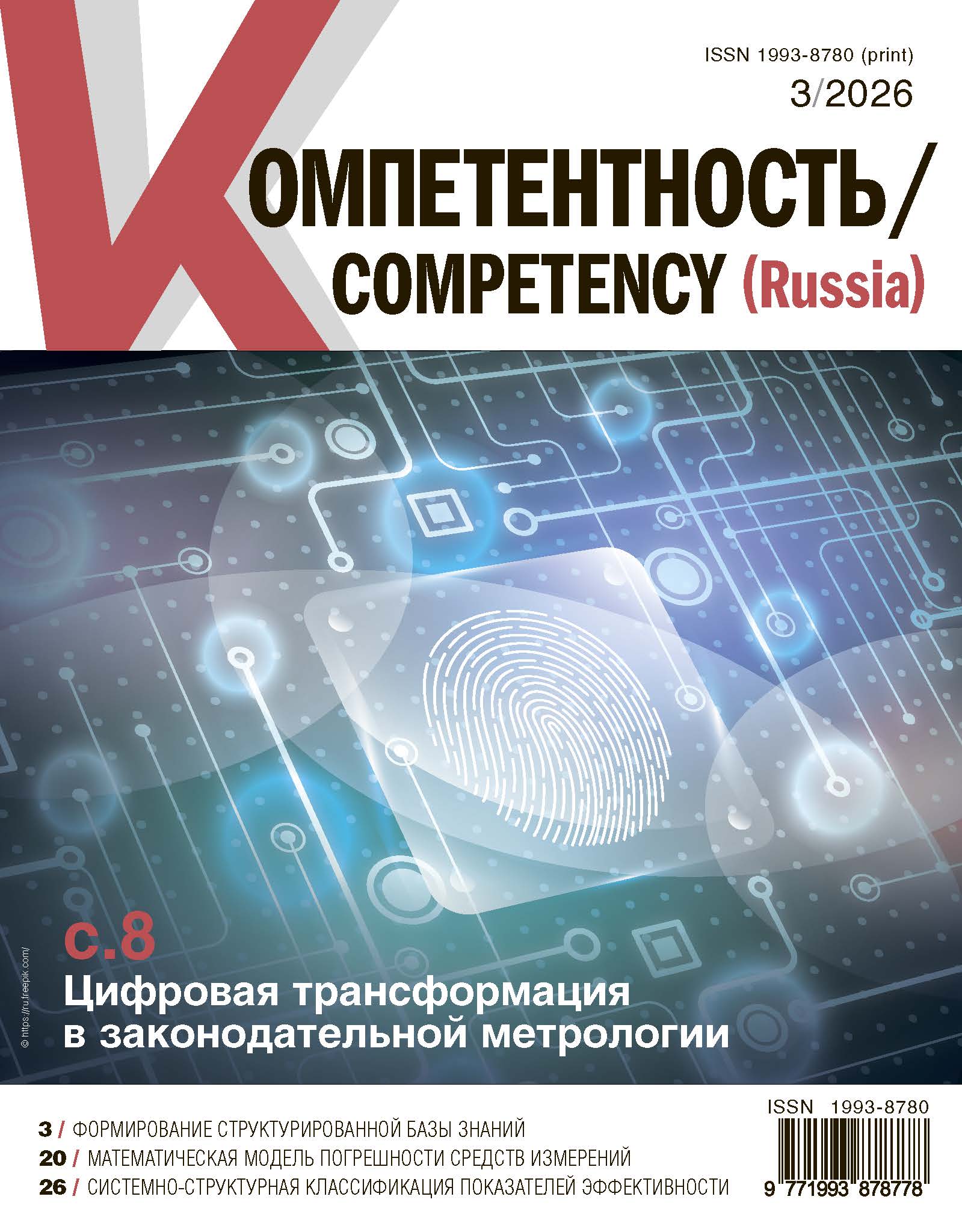
Digital Transformation in Legal Metrology: the Russian Context
Authors: N.V. Korostin, MIREA — Russian Technological University (RTU MIREA), ykorostinnk@gmail.comE.V. Kopylova, RTU MIREA, kopylova_e@mirea.ru R.Sh. Mansurov1 , RTU MIREA, mansurovrusl@mail.ruA.N. Pan’kov, Research Center for Applied Metrology — Rostest, Academy for Standardization, Metrology and Certification (Training), RTU MIREA, PhD (Tech.), AndreyyNP@rostest.ruAt the international level, there is an understanding that the digital transformation of metrology is a necessary condition for the development of the industry in the 21st century. The key areas of this transformation range from digital data and documents to the use of artificial intelligence and new forms of standards. This article analyzes the digital transformation of legal metrology based on initiatives of the International Bureau of Weights and Measures (BIPM) and the International Organization of Legal Metrology (OIML). Key trends are discussed: document digitization, application of FAIR principles, and the use of digital certificates. The need for Russia’s active participation in this process to ensure international comparability and trust is emphasized.DOI: 10.24412/1993-8780-2026-3-08-15
Download -
3
Intelligent Technologies for Assessing the Road Condition
Authors: O.V. Knyaz’kina, Siberian State Industrial University (SibSIU), Assoc. Prof. PhD (Tech.), dmtov@mail.ruA.A. Abaturova, SibSIU, PhD (Tech.), anchutka-82@mail.ruR.M. Khamitov, Kazan State Power Engineering University, Assoc. Prof. PhD (Tech.), hamitov@gmail.comMaintaining the transport network in a regulatory state and achieving the target indicators within the framework of the national project Safe high-quality roads is a crucial state task. To achieve these goals, it is necessary to have a unified adaptive metrological support for monitoring the condition of roads and making management decisions about carrying out repairs. We have proposed a procedure for the operation of a smart system for continuous monitoring of measurement and assessment of road condition. This system enables the automatic detection of road defects in real time using AI technologies. The use of AI technologies and Big Data analysis not only allows for monitoring the dynamics of road condition changes during operation but can also serve as a primary management tool.DOI: 10.24412/1993-8780-2026-3-16-19
Download -
4
Mathematical Model and Definition of the Effective Error of Measuring Instruments
Authors: Sh.A. Kadirova, Karimov Tashkent State Technical University (Karimov TSTU), Prof. PhD (Tech.)M.M. Makhmudzhonov, Karimov TSTU, Assoc. Prof. PhD (Tech.), mirolim.maxmudjonov@tdtu.uzMeasurement is an information process of obtaining a numerical value of a measured quantity by experiment. Any measurement is performed with some error, which distorts the measurement result and allows to determine only an approximate value of the measured quantity. Errors limit the number of reliable significant digits of the numerical value of the measured quantity and are characterized by the difference between the measured value and the true value of the measured quantity. The article presents a mathematical model of measurement errors based on probability theory and mathematical statistics. Expressions for estimating basic and additional errors with correlated components are provided. The least squares method is applied to process experimental data. The obtained results improve the reliability of metrological measurement assessment.DOI: 10.24412/1993-8780-2026-3-20-25
Download -
5
Systemic-Structural Classification of Technical and Economic Efficiency Indicators
Authors: N.N. Karzaeva, Mendeleev University of Chemical Technology of Russia (MUCTR), Prof. Dr. (Ec.), k-nn@yandex.ruM.M. Samoshkin, MUCTR, mik4836@yandex.ruThe indicators of technical and economic efficiency are the most important indicators of the current state of the organization’s functioning. They are most significant in assessing the energy and resource efficiency of the company, and they also play a key role in the formation and further implementation of the enterprise management model. The article formulates the definition of technical and economic efficiency, substantiates the integrative-hierarchical systematization of indicators characterizing its level. The essence of this systematization is to separate all indicators by levels of managerial decision-making (hierarchy), and within the level by types of effectiveness (integration of disparate aspects of effectiveness).DOI: 10.24412/1993-8780-2026-3-26-32
Download -
6
Risk Management in East — West Supply Chains Based on ERAI-RC Integral Index
Authors: A.R. Kurtikova, Institute of International Trade and Sustainability Development of Moscow State Institute of International Relations (University) of the Ministry of Foreign Affairs of the Russian Federation (IITSD of MGIMO University)E.R. Kurtikova, Institute of Operation and Digital Technologies of Russian University of Transport (MIIT)I.Z. Aronov, IITSD of MGIMO University, Russian Standardization Institute, Dr. (Tech.)ERAI (Eurasian Rail Alliance Index) is a standardized indicator of the cost of container transportation by rail through countries with a 1520 mm track gauge. Developed as a tool to increase market transparency, ERAI has evolved into a recognized benchmark for comparing the cost of logistics routes. The article evaluates the analytical potential of ERAI for proactive risk management. We have found that standard ERAI, while a benchmark for cost monitoring, has low sensitivity to operational and geopolitical shocks. As a solution, we have proposed the concept of ERAI-Risk Composite index, integrating subindexes for spot cost, resource availability, and reliability. This approach transforms ERAI into a predictive diagnostic system for the early identification of threats and the enhancement of logistics operations resilience.DOI: 10.24412/1993-8780-2026-3-33-37
Download -
7
Implementation of an Automated Control System for a Fueling Complex
Authors: I.I. Idrisov, Kazan National Research Technological University (KNRTU), idrisoviskander@gmail.comF.F. Galimulina, KNRTU, Assoc. Prof. Dr. (Ec.), 080502e_m@mail.ruThe high rate of digitalization in the Russian Federation determines the intensive process of automating the control for fueling complexes. On the one hand, this is due to the development trajectory outlined by the government, and on the other hand, it is due to the operational advantages for business entities. Automated control systems for fueling stations represent comprehensive hardware and software solutions aimed at improving the efficiency of fuel retailers and reducing operating costs. This article describes the basic architecture of an automated control system for fueling stations, including its key modules, and analyzes the impact of such a system on the operational performance of an organization. It is concluded that modern automated control systems provide a sustainable competitive advantage by reducing operational costs.DOI: 10.24412/1993-8780-2026-3-38-43
Download -
8
Development of a Methodology for Assessing the Company Loyalty as Part of an Organization Quality Culture Assessment
Authors: M.M. Mityugina, Ulyanov Chuvash State University (Ulyanov ChuvSU), Assoc. Prof. PhD (Ec.), mityuginamm@gmail.comT.V. Kravchenko, Ulyanov ChuvSU, PhD (Ec.), dtv1981@yandex.ruQuality culture refers to the shared values, beliefs, attitudes, and behaviors within an organization that prioritize continuous improvement and customer satisfaction, as well as ensuring the company’s commitment to producing high-quality products and services. In the article, the theoretical and methodological foundations of building a methodology for assessing the loyalty of a company within the framework of assessing the quality culture of an organization are considered, the approaches and tools available to date for assessing the loyalty of a company are studied, and an author’s model for assessing the loyalty of a company based on the use of subjective indicators is proposed.DOI: 10.24412/1993-8780-2026-3-44-49
Download -
9
Improving the Tools for Assessing and Monitoring the Quality of Complex Devices
Authors: V.S. Vasil’eva, St. Petersburg State University of Aerospace Instrumentation, victoria-vasilyeva@mail.ruThe development of scientific and technological progress is accompanied by the introduction of increasingly complex technical systems and hardware and software systems. Therefore, the implementation of innovative development models and virtual testing methods, which improve the quality of both hardware solutions and data processing, is particularly relevant. The increasing complexity of architecture and the increasing number of components increases the risk of reduced reliability and durability of devices. Traditional approaches based on physical testing and element- by-element duplication prove to be technically limited and cost-ineffective. The innovative model of developing software systems for processing Big Data, discussed in the article, in combination with virtual modeling tools and digital twins, demonstrates high efficiency in improving the quality of complex devices. This approach provides comprehensive risk management, reduces the time and cost of testing, and allows for the design of more reliable and durable systems.DOI: 10.24412/1993-8780-2026-3-50-52
Download -
10
Measures to Stimulate Technological Development Applied in the Republic of Tatarstan
Authors: P.V. Pobedinskiy, Institute for Regional Economic Research (IRER), peter.pobedinskiy@yandex.ruT.I. Zvorykina, IRER, Prof. Dr. (Ec.), Honored Scientist of the Russian Federation, sss2800@mail.ruThe goal of the study is to analyze the current state and prospects of the regional economic policy of the Republic of Tatarstan in the context of ensuring the technological sovereignty of the Russian Federation. In the paper we have examined the regional support measures during the 2024–2025 period. The research methods rely on a qualitative analysis of normative legal acts, including the State program Scientific and technological development of the Republic of Tatarstan for 2024–2027 and the recently adopted Law On the development of responsible business. The methodological framework includes the ecosystem approach to innovation management in the regional economy. The results of conducted analysis reveal that the region has transitioned from forming an ecosystem approach to deepening integration within the innovation ecosystem. A review of program budget allocation shows a strategic priority on human capital development and developing the new economy sectors. The scientific results confirm that the region heavily participates in cooperation with other state regions and federal institutions, combining regional funding with federal support instruments. The conclusion was made that the applied measures are complex and deeply integrated with the specific strengths and weaknesses of the Republic of Tatarstan as a competitive region.DOI: 10.24412/1993-8780-2026-3-53-58
Download